After shipping Chokidar 3 file watcher — you may have it on your machine if you’re coding in VSCode — i’ve started diving more into cryptography. It’s very useful to know how those algorithms work, to be able to verify them & to create safe systems.
It was immediately clear that Elliptic Curve Cryptography (ECC) libraries must be improved. In this post i’ll describe how to make one of the fastest JS implementations of secp256k1, that can be audited by non-cryptographers. The initial working code will fit in 856 bytes.
- State of cryptography in JS
- Naïve first take
- Public keys
- Signatures
- Randomness and PlayStation
- Fighting timing attacks
- BigInts, JIT, GC and other scary words
- Projecting…coordinates?
- Precomputes and wNAF
- Endomorphism
- Endgame: combining everything
- Extra tricks
- Final thoughts and source code
State of cryptography in JS
The state of JavaScript cryptography can be summed up in one word: “sad”:
- Dependency Hell: Many libraries are bloated with dependencies. As i’ve mentioned before, every dependency is a potential security vulnerability — any underlying package could get hacked & malwared. This is unacceptable for cryptographic primitives, which are made to defend user secrets.
- Bad WebCrypto: The
window.cryptostandard is complicated and lacks support for popular curves like secp256k1. Those APIs which do exist are terrible and make it easy to shoot oneself in the foot. - Unverifiable WASM: While WASM offers performance benefits, it lacks transparency and auditability. There is no infrastructure for reproducible builds and code signing. Everybody just downloads opaque binaries, which could easily be infested.
- Modular Arithmetic Issues: JavaScript’s % operator is a remainder operator, not a true modulo, which necessitates re-implementing basic operations.
Naïve first take
Taking all of this into consideration, i’ve decided to create TypeScript libraries that don’t use dependencies & are simple to audit for everyone. Having no “deep” math background, it wasn’t that simple. Cloudflare blog post, Nakov’s book and Andrea’s blog post have all been very useful.
And you can’t just go ahead and read through the code. Almost every implementation — even in Haskell — works with unreadable and highly optimized code. In the real world, we’ll see something more like:
for (i = 254; i >= 0; --i) {
  r = (z[i >>> 3] >>> (i & 7)) & 1;
  sel25519(a, b, r);
  sel25519(c, d, r);
  A(e, a, c);
  Z(a, a, c);
  A(c, b, d);
  Z(b, b, d);
  S(d, e);
}
(To be fair, that snippet is a Montgomery ladder — a constant-time multiplication technique, and we’ll spend a whole section fighting timing attacks later. Dense code is sometimes dense for a reason; it just shouldn’t be the only option.)
The only lib i’ve found useful was fastecdsa.py. Unfortunately, it’s rare for libraries to be built on top of big integers. It’s much easier to reason about numbers than about the byte arrays everyone else prefers.
Public keys
We will start with a function that takes private key and generates public key from it.
To generate a public key from a private key using elliptic curve cryptography (ECC), you need to perform elliptic curve point multiplication. This involves multiplying the base (generator) point
G by the private key d to obtain the public key Q:
Q = G × d
Multiplication can be thought of as repeated addition of the base point G+G+G... — d times.
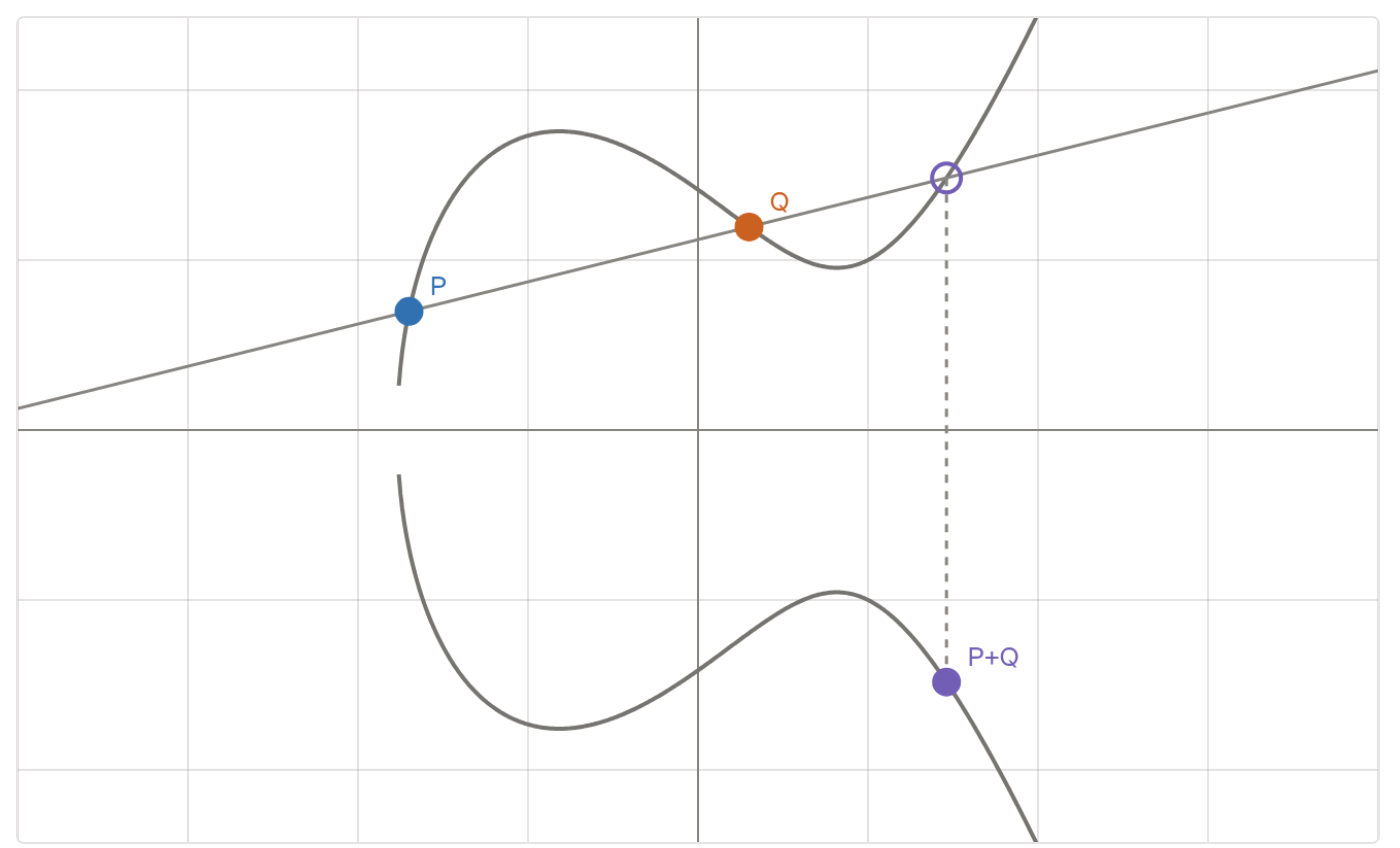
How do we add (x1, y1) + (x2, y2) to get (x3, y3)?
- Imagine drawing a straight line between the two points P and Q on the elliptic curve
- This line will generally intersect the curve at a third point R’
- Reflect R’ vertically (i.e., flip the y-coordinate) to get the sum R = P + Q with coordinates
(x3, y3)- This reflection is what makes point subtraction work correctly. Since R = P + Q, computing R - Q must give back P: flip Q’s y-coordinate, draw the line between R and -Q, and the construction indeed lands on P.
- There is a special case for doubling. When a point is added to itself, we can’t draw a straight line. Instead, we calculate the slope (λ, lambda) of the tangent line at the point.
- There is a special case for adding a point to its own reflection:
P + -Pshould equal0(special point-at-infinity)
In math terms (source):
- if
x1 != x2:L = (y2-y1)/(x2-x1)x3 = L^2 - x1 - x2y3 = L(x1 - x3) - y1
- if
x1 = x2andy1 = y2(point doubling):L = (3*x1^2+a)/(2y1)x3 = L^2 - 2*x1y3 = L(x1 - x3) - y1
Simple, but not quite. Keep in mind: we’re working in a finite field of prime order P. This basically means all operations — additions, multiplications, subtractions — would be done modulo P. And, there is no classic division in finite fields. Instead, a modular multiplicative inverse is used. We’ll compute it via Fermat’s little theorem: for prime p, a^(p-2) ≡ a^(-1) (mod p). A variable-time extended Euclidean GCD (egcd) inversion is ~10x faster and can be swapped in as a speed-up — but its running time depends on the value being inverted, which is a timing leak when that value is secret, like the nonce in ECDSA signing. Fermat’s exponent is a public constant, so its sequence of operations never depends on the secret.
Let’s code this:
// PART 1: unsafe pub
// secp256k1 curve parameters. Verify using https://www.secg.org/sec2-v2.pdf
const _256 = 2n ** 256n;
const P = _256 - 0x1000003d1n; // curve's field prime
const N = _256 - 0x14551231950b75fc4402da1732fc9bebfn; // curve (group) order
const err = (m = ''): never => { throw new Error(m); }; // error helper
const M = (a: bigint, b: bigint = P) => {
  // mod division
  const r = a % b;
  return r >= 0n ? r : b + r; // a % b = r
};
// Modular inversion via Fermat's little theorem: a^(md-2) ≡ a^(-1) (mod md).
// Only valid for prime md. The exponent is public, so the operation sequence
// never depends on the inverted value — unlike the faster, variable-time egcd.
const inv = (num: bigint, md: bigint = P): bigint => {
  if (num === 0n || md <= 0n) err('no inverse');
  let x = M(num, md), r = 1n;
  for (let e = md - 2n; e > 0n; e >>= 1n) {
    if (e & 1n) r = r * x % md;
    x = x * x % md;
  }
  return r;
};
// Point in 2d affine (x, y) coordinates
interface AffinePoint {
  x: bigint;
  y: bigint;
}
const affine = (x: bigint, y: bigint): AffinePoint => ({ x, y });
// Point at infinity aka identity point aka zero. Using (0, 0) as a sentinel
// only works because (0, 0) is not on this curve: 0² ≠ 0³ + 7
const Point_ZERO = { x: 0n, y: 0n };
const isZero = (p: AffinePoint) => p.x === 0n && p.y === 0n;
// Adds point to itself. https://hyperelliptic.org/EFD/g1p/auto-shortw.html
const pdouble = (a: AffinePoint) => {
  const X1 = a.x, Y1 = a.y;
  // Calculates slope of the tangent line
  const lam = M(3n * X1 ** 2n * inv(2n * Y1)); // λ = (3x₁² + a) / (2y₁); a=0 in secp256k1
  const X3 = M(lam * lam - 2n * X1); // x₃ = λ² - 2x₁
  const Y3 = M(lam * (X1 - X3) - Y1); // y₃ = λ * (x₁ - x₃) - y₁
  return affine(X3, Y3);
};
// Adds point to other point. https://hyperelliptic.org/EFD/g1p/auto-shortw.html
const padd = (a: AffinePoint, b: AffinePoint): AffinePoint => {
  const X1 = a.x, Y1 = a.y, X2 = b.x, Y2 = b.y;
  if (isZero(a)) return b;
  if (isZero(b)) return a;
  if (X1 === X2 && Y1 === Y2) return pdouble(a); // special case
  if (X1 === X2 && Y1 === M(-Y2)) return Point_ZERO; // special case
  const lam = M((Y2 - Y1) * inv(X2 - X1));
  const X3 = M(lam * lam - X1 - X2);
  const Y3 = M(lam * (X1 - X3) - Y1);
  return affine(X3, Y3);
};

/** Generator / base point */
// G x, y values taken from official secp256k1 document: https://www.secg.org/sec2-v2.pdf
const Gx = 0x79be667ef9dcbbac55a06295ce870b07029bfcdb2dce28d959f2815b16f81798n;
const Gy = 0x483ada7726a3c4655da4fbfc0e1108a8fd17b448a68554199c47d08ffb10d4b8n;
const Point_BASE = affine(Gx, Gy);
const mul_unsafe = (q: AffinePoint, n: bigint) => {
  let curr = q; // points are immutable, no copy needed
  let p = Point_ZERO;
  while (n > 0n) {
    if (n & 1n) p = padd(p, curr);
    curr = pdouble(curr);
    n >>= 1n;
  }
  return p;
};
const _getPublicKey = (privateKey: bigint): AffinePoint => {
  return mul_unsafe(Point_BASE, privateKey);
};
Yay, it works.
Signatures
A good ECC library should also be able to produce & verify signatures. Formulas for ECDSA sigs are simple.
Let:
mbe the hash of the message, converted to a number.dbe the private key, converted to a number.kbe the secret (random) nonce number.Gbe the generator point.nbe the order of the curve.
Then the signing process is defined as:
(x_1, y_1) = G × k
r = x_1 mod n
s = k^-1 ⋅ (m + d⋅r) mod n
For verification, given:
r, sas the signature outputsQas the public key corresponding to the private keyd.
u_1 = s^-1 ⋅ m mod n
u_2 = s^-1 ⋅ r mod n
(x_2, y_2) = G × u_1 + Q × u_2
x_2 mod n == r
Let’s code them:
// PART 2: unsafe sigs

interface Signature {
  r: bigint;
  s: bigint;
  recovery?: number;
}
// Convert Uint8Array to bigint, big endian
const bytesToNumBE = (bytes: Uint8Array): bigint =>
  bytes.reduce((n, byte) => (n << 8n) | BigInt(byte), 0n);
// ECDSA uses leftmost min(|hash|, |n|) bits of the hash:
// hashes longer than 32 bytes (e.g. SHA-384) must be truncated
const hashToNum = (msgh: Uint8Array): bigint => bytesToNumBE(msgh.subarray(0, 32));
// Get random k from CSPRNG.
// (rand32 mod N) is naive version
// (rand48 mod N-1)+1 is ours, proper version.
// +16 more bytes are fetched to make modulo bias small.
// (mod N-1)+1 is done to eliminate 0 from output.
const randK = (): bigint => {
  const b = crypto.getRandomValues(new Uint8Array(48));
  const num = M(bytesToNumBE(b), N - 1n);
  return num + 1n;
};
const _sign = (msgh: Uint8Array, d: bigint): Signature => {
  const m = M(hashToNum(msgh), N);
  let r = 0n;
  let s = 0n;
  let q: AffinePoint;
  do {
    const k = randK();
    const ik = inv(k, N);
    q = mul_unsafe(Point_BASE, k);
    r = M(q.x, N);
    s = M(ik * M(m + d * r, N), N);
  } while (r === 0n || s === 0n);
  if (s > N >> 1n) {
    s = M(-s, N);
  }
  return { r, s };
};
const _verify = (sig: Signature, msgh: Uint8Array, pub: AffinePoint): boolean => {
  const { r, s } = sig;
  if (r <= 0n || r >= N || s <= 0n || s >= N) return false; // else inv() would throw
  const h = M(hashToNum(msgh), N);
  const is = inv(s, N);
  const u1 = M(h * is, N);
  const u2 = M(r * is, N);
  const G_u1 = mul_unsafe(Point_BASE, u1);
  const P_u2 = mul_unsafe(pub, u2);
  const R = padd(G_u1, P_u2);
  if (isZero(R)) return false; // point at infinity: invalid
  return M(R.x, N) === r;
};
Randomness and PlayStation
You may have noticed we’re using this weird algorithm for generating a random k.
Why is that important?
Turns out, if you reuse k to sign two different messages under the same private key,
your key would get exposed and leaked. It’s really bad.
There are two common ways of solving this situation:
- Fetch
kfrom a secure source of randomness (CSPRNG)- The most famous k-reuse failure is the PlayStation 3 signing key leak: Sony’s firmware signer used the same
kfor every signature — no randomness at all — so two signatures were enough to solve for the private key - The CSPRNG itself can fail too: in 2013, Android’s SecureRandom could repeat outputs, producing duplicate
k’s in Bitcoin wallets — attackers scanned the blockchain for repeated nonces and stole coins - This is a real risk on devices which are not able to gather enough entropy
- Entropy generator could also be malicious (backdoored)
- The most famous k-reuse failure is the PlayStation 3 signing key leak: Sony’s firmware signer used the same
- Calculate
kfromprivandmsghdeterministically. RFC6979 does exactly that, by using HMAC-DRBG- Got massive adoption these days
- The DRBG seems a bit complicated: perhaps, if the RFC was created later, they could have just used something like HKDF
- While the method protects against bad randomness, it does not protect against so-called “fault attacks”:
glitch the hardware while it signs the same message twice — one run correct, one faulted — and
both runs use the same deterministic
k. Two different signatures sharing akreveal the private key, just like in the PS3 case.
In the article we implement 1 for simplicity, while in the library we implement 2. Article’s version has some important tricks, like using the FIPS 186-4 B.4.1 technique to fetch more randomness than necessary and eliminate zeros from produced values.
Combining 1 and 2 is the best approach and described in RFC6979 3.6 (additional k). It’s called “hedged signatures” / “deterministic signatures with noise” / “extra entropy”.
Fighting timing attacks
Timing attacks are a type of side-channel attack where an adversary measures how long your algorithms take to execute, leveraging variations in execution time to infer secret information. (More advanced side-channel methods even analyze power consumption.)
Not all timing attackers are equal. Three classes, from hardest to easiest:
- Remote: the attacker talks to your server over the network — say, sends 100,000 requests to a
/signendpoint and times the responses. Network jitter buries small signals, so they need huge sample counts and fairly large leaks. Still, it has been pulled off over a real network against OpenSSL RSA in 2003. - Same machine, different tenant: the attacker rents a VM or container on the same cloud host, or runs an app on the same device. No network noise, and shared CPU caches let them watch your memory-access patterns — this is the home turf of cache-timing and Spectre-class attacks.
- Same process: the attacker’s code runs in your runtime — e.g. a third-party script timing your functions with
performance.now(). The cleanest signal of all. Though at that point timing is the least of your worries: code in your process can usually just read the keys directly. Which is why zero dependencies matter as much as constant time.
To mitigate these risks, cryptographic software must operate in constant time: execution time must not depend on secrets. A classic example is comparing two MACs: a naive comparison returns at the first mismatching byte, so its timing leaks how many leading bytes the attacker got right — a constant-time comparison always processes the full length.
Let’s see if we’re protected right now:
const measure = (label: string, fn: () => void) => {
  console.time(label);
  fn();
  console.timeEnd(label);
};
measure("small DA", () => mul_unsafe(Point_BASE, 2n));
measure("large DA", () => mul_unsafe(Point_BASE, 2n ** 255n - 19n));
// small DA: 0.409ms
// large DA: 36.154ms
~90x difference, depending on the private key. Seems like we are not protected.
mul_unsafe leaks in two distinct ways:
- The loop
while (n > 0n)runs once per bit, so total time leaks the bit length of the key. That’s what the benchmark above shows:2nis a 2-bit number,2^255 - 19is a 256-bit one. paddis only called when the current bit is1, so time also leaks the Hamming weight of the key — how many of its bits are set.
The fix is to do identical work for every scalar: always run a fixed number of iterations, and always do an addition in each one. When the bit is 1, add to the result as usual. When the bit is 0, add to a fake point that gets thrown away:
// PART 3: safe mul

// Constant Time multiplication
const getPowers = (q: AffinePoint) => {
  const points: AffinePoint[] = [];
  for (let bit = 0, dbl = q; bit <= 256; bit++, dbl = pdouble(dbl)) {
    points.push(dbl);
  }
  return points;
};
const mul_CT_slow = (q: AffinePoint, n: bigint) => {
  const pows = getPowers(q);
  let p = Point_ZERO;
  let f = Point_ZERO; // fake point
  for (let bit = 0; bit <= 256; bit++) {
    const at_bit_i = pows[bit];
    if (n & 1n) p = padd(p, at_bit_i);
    else f = padd(f, at_bit_i);
    n >>= 1n;
  }
  return p;
};
Let’s measure the new multiplication:
measure("small CT", () => mul_CT_slow(Point_BASE, 2n));
measure("large CT", () => mul_CT_slow(Point_BASE, 2n ** 255n - 19n));
// small CT: 35.211ms
// large CT: 35.295ms
Now it is slower on average, but the amount of work no longer depends on the key.
Two caveats. First, this equalizes the number of point operations, not their exact timing: padd still branches on its inputs. This is “algorithmic constant-time”, not the real thing. Second, the trick assumes the fake point is actually computed: a clever JIT could notice f is never used and skip the work entirely. That’s why the final code returns the fake point alongside the real one and calls toAffine() on it, ignoring the result.
Fortunately, for a typical web app the realistic attacker is remote — the hardest class. Breaches are far more likely to come from a malicious third-party dependency, which doesn’t need a stopwatch.
BigInts, JIT, GC and other scary words
Native JS BigInts are often labeled “unsuitable for cryptography” because their operations aren’t guaranteed to be constant-time. That’s true — but our numbers are all the same size. V8 stores bigints in 64-bit limbs: a field element is 4 limbs, a product is 8. Same limb count means same work, whatever the values. What leaks past that — tiny value-dependent steps inside division — shows up in a lab microbenchmark, not across a network. Mounting a timing attack against an algorithmically constant-time Point#multiply built on BigInts would take vastly more effort than exploiting the leaks we just fixed. Re-implementing bigints purely to chase constant-time arithmetic is not worth it.
It’s also important to acknowledge that JavaScript is a dynamic language, and some of its machinery disrupts any constant-time guarantee:
- Garbage collection: a function that normally executes in 5ms might take 7ms when the JS engine performs object reclamation.
- Just-in-time compilation: the optimizations and deoptimizations by modern JIT compilers lead to variation in execution times based on context.
Thus, whether we use native BigInts or a custom implementation like bn.js (which is thousands of lines of code), true “constant-time” is impossible in JavaScript. The best we can do is algorithmic constant-time & removing dependencies which make us more likely to get malwared.
Projecting…coordinates?
Right now, our call structure consists of:
- Initialization: 256 doubles
- Multiplication: 256 adds
Let’s dive into what actually happens inside the add and double operations. Both of these functions perform several additions and multiplications, and crucially, each includes one invert (i.e., finite field division). Profiling reveals that invert is extremely slow — our Fermat version costs hundreds of multiplications — and each scalar multiplication might involve up to 512 inverts.
Projective (or homogeneous) coordinates provide an elegant solution by eliminating these costly inversions from both functions. Note that our default x, y coordinates are in Affine form. In projective coordinates, a point is represented by the triple (X, Y, Z); conversion between representations is straightforward. To convert from Projective to Affine, we use:
Ax = X / Z;
Ay = Y / Z;
Recall that m/n = m * inv(n).
Converting a point to Projective form is even simpler: we set Z to 1, and copy X and Y directly.
We’ll also implement a dedicated Point#add method using the Renes-Costello-Batina 2015 exception-free addition formulas. “Exception-free” means those formulas avoid conditional branches, such as checking whether two points are identical (or zero), as seen in our initial mul implementation. Using such formulas is important for constant-timeness. Since the formulas are complete, doubling can simply reuse add — a dedicated doubling formula would shave another ~30%, which we skip for brevity.
Finally, we will modify our getPowers function to operate exclusively on Point objects, converting them back to Affine form via Point#toAffine() just before returning results.
// PART 4: proj mul

const CURVE = { P: P, n: N, a: 0n, b: 7n };
const equals = (a: AffinePoint, b: AffinePoint) => a.x === b.x && a.y === b.y;
// Point in 3d projective (x, y, z) coordinates
class Point {
  px: bigint;
  py: bigint;
  pz: bigint;
  constructor(x: bigint, y: bigint, z: bigint) {
    this.px = x;
    this.py = y;
    this.pz = z;
  }
  /** Create 3d xyz point from 2d xy. Edge case: (0, 0) => (0, 1, 0), not (0, 0, 1) */
  static fromAffine(p: AffinePoint): Point {
    return p.x === 0n && p.y === 0n ? new Point(0n, 1n, 0n) : new Point(p.x, p.y, 1n);
  }
  toAffine(iz?: bigint): AffinePoint {
    if (this.pz === 0n) return { x: 0n, y: 0n }; // identity: z=0 has no inverse
    if (iz === undefined) iz = inv(this.pz, P);
    const x = M(this.px * iz);
    const y = M(this.py * iz);
    return { x, y };
  }
  // prettier-ignore
  add(other: Point) {
    const { px: X1, py: Y1, pz: Z1 } = this;
    const { px: X2, py: Y2, pz: Z2 } = other;
    const { a, b } = CURVE;
    let X3 = 0n, Y3 = 0n, Z3 = 0n;
    const b3 = M(b * 3n); // step 1
    let t0 = M(X1 * X2), t1 = M(Y1 * Y2), t2 = M(Z1 * Z2), t3 = M(X1 + Y1);
    let t4 = M(X2 + Y2);                                // step 5
    t3 = M(t3 * t4); t4 = M(t0 + t1); t3 = M(t3 - t4); t4 = M(X1 + Z1);
    let t5 = M(X2 + Z2);                                // step 10
    t4 = M(t4 * t5); t5 = M(t0 + t2); t4 = M(t4 - t5); t5 = M(Y1 + Z1);
    X3 = M(Y2 + Z2);                                    // step 15
    t5 = M(t5 * X3); X3 = M(t1 + t2); t5 = M(t5 - X3); Z3 = M(a * t4);
    X3 = M(b3 * t2);                                    // step 20
    Z3 = M(X3 + Z3); X3 = M(t1 - Z3); Z3 = M(t1 + Z3); Y3 = M(X3 * Z3);
    t1 = M(t0 + t0);                                    // step 25
    t1 = M(t1 + t0); t2 = M(a * t2); t4 = M(b3 * t4); t1 = M(t1 + t2);
    t2 = M(t0 - t2);                                    // step 30
    t2 = M(a * t2); t4 = M(t4 + t2); t0 = M(t1 * t4); Y3 = M(Y3 + t0);
    t0 = M(t5 * t4);                                    // step 35
    X3 = M(t3 * X3); X3 = M(X3 - t0); t0 = M(t3 * t1); Z3 = M(t5 * Z3);
    Z3 = M(Z3 + t0);                                    // step 40
    return new Point(X3, Y3, Z3);
  }
  double() {
    // add() uses complete formulas, so doubling through it is correct;
    // a dedicated dbl formula would be ~30% faster
    return this.add(this);
  }
  negate() {
    return new Point(this.px, M(-this.py), this.pz);
  }
}
const Proj_ZERO = Point.fromAffine(Point_ZERO);
const Proj_BASE = Point.fromAffine(Point_BASE);
const getPowersProj = (qxy: AffinePoint): Point[] => {
  const q = Point.fromAffine(qxy);
  const points: Point[] = [];
  for (let bit = 0, dbl = q; bit <= 256; bit++, dbl = dbl.double()) {
    points.push(dbl);
  }
  return points;
};
const mul_CT = (q: AffinePoint, n: bigint) => {
  const pows = getPowersProj(q);
  let p = Proj_ZERO;
  let f = Proj_ZERO; // fake point
  for (let bit = 0; bit <= 256; bit++) {
    const at_bit_i = pows[bit];
    if (n & 1n) p = p.add(at_bit_i);
    else f = f.add(at_bit_i);
    n >>= 1n;
  }
  return p.toAffine();
};
Let’s see how this improves things for us:
CT proj: 1.5ms
Woah! That’s a 23x improvement for multiply. Projective coordinates pay off doubly with Fermat inversion, since each eliminated invert was so expensive.
Precomputes and wNAF
Currently, multiplication does one point addition for each of the 256 bits of the scalar.
The simplest optimization would be to cache the result of getPowers.
This way, powers of G would get precomputed once and for all.
Instead of doing that, let’s get more efficient and split scalar into 4/8/16-bit chunks, pre-compute powers AND additions within those chunks.
w-ary non-adjacent form method (wNAF) allows to do exactly that. Instead of caching 256 points like we did before, we would cache 520 (W=4), 4224 (W=8) or 557056 (W=16) points.
We could also do this with alternative, “windowed method”, but wNAF saves us ½ RAM and is 2x faster in init time. The reason for this is that wNAF does addition and subtraction — and for subtraction it simply negates point, which can be done in constant time.
// PART 5: wnaf mul

const W = 8; // Precomputes-related code. W = window size
// prettier-ignore
const precompute = () => {                              // They give ~6x faster getPublicKey(),
  const points: Point[] = [];                           // ~5x sign(), 2x verify(). To achieve this,
  const windows = 256 / W + 1;                          // app needs to spend ~15ms to calculate
  let p = Proj_BASE, b = p;                  // a lot of points related to base point G.
  for (let w = 0; w < windows; w++) {                   // Points are stored in array and used
    b = p;                                              // any time Gx multiplication is done.
    points.push(b);                                     // They consume ~1 MiB of RAM.
    for (let i = 1; i < 2 ** (W - 1); i++) { b = b.add(p); points.push(b); }
    p = b.double();                                     // Precomputes don't speed-up getSharedKey,
  }                                                     // which multiplies user point by scalar,
  return points;                                        // when precomputes are using base point
};
let Gpows: Point[] | undefined = undefined; // precomputes for base point G
// prettier-ignore
const wNAF = (n: bigint): { p: Point; f: Point } => {   // w-ary non-adjacent form (wNAF) method.
                                                        // Compared to other point mult methods,
  const comp = Gpows || (Gpows = precompute());         // stores 2x less points using subtraction
  const neg = (cnd: boolean, p: Point) => { let n = p.negate(); return cnd ? n : p; } // negate
  let p = Proj_ZERO, f = Proj_BASE;// f must be G, or could become I in the end
  const windows = 1 + 256 / W;                          // W=8 17 windows
  const wsize = 2 ** (W - 1);                           // W=8 128 window size
  const mask = BigInt(2 ** W - 1);                      // W=8 will create mask 0b11111111
  const maxNum = 2 ** W;                                // W=8 256
  const shiftBy = BigInt(W);                            // W=8 8
  for (let w = 0; w < windows; w++) {
    const off = w * wsize;
    let wbits = Number(n & mask);                       // extract W bits.
    n >>= shiftBy;                                      // shift number by W bits.
    if (wbits > wsize) { wbits -= maxNum; n += 1n; }    // split if bits > max: +224 => 256-32
    const off1 = off, off2 = off + Math.abs(wbits) - 1; // offsets, evaluate both
    const cnd1 = w % 2 !== 0, cnd2 = wbits < 0;         // conditions, evaluate both
    if (wbits === 0) {
      f = f.add(neg(cnd1, comp[off1]));                 // bits are 0: add garbage to fake point
    } else {                                            //          ^ can't add off2, off2 = I
      p = p.add(neg(cnd2, comp[off2]));                 // bits are 1: add to result point
    }
  }
  return { p, f }                                       // return both real and fake points for JIT
}; // !! you can disable precomputes by commenting-out call of the wNAF() inside Point#mul()
const mul_G_wnaf = (n: bigint) => {
  const { p, f } = wNAF(n);
  f.toAffine(); // result ignored
  return p.toAffine();
};
Let’s see where this lands us:
mul_G_wnaf: 0.243ms
So, 6x faster; even though init got slightly slower. You may have noticed that it’s possible to adjust wNAF W parameter: it specifies how many precomputed points we’ll calculate.
Endomorphism
Let’s get hardcore. But not too much — otherwise, the code would be unauditable.
To improve performance even more, we must look at the properties at our underlying elliptic curve.
secp256k1 is a Koblitz curve (i.e. a Short Weierstrass curve with a=0).
Koblitz curves allow using efficiently-computable GLV endomorphism ψ:
- GLV endomorphism ψ transforms a point:
P = (x, y) ↦ ψ(P) = (β·x mod p, y) - GLV scalar decomposition transforms a scalar:
k ≡ k₁ + k₂·λ (mod n) - Then these are combined:
k·P = k₁·P + k₂·ψ(P) - Two 128-bit point-by-scalar multiplications + one point addition is faster than one 256-bit multiplication.
For arbitrary-point multiplication — ECDH, key recovery — endomorphism is a pure ~20% speed-up. For precomputed wNAF over the base point it is a trade-off: precomputation gets 2x faster and uses 2x less RAM, at the cost of ~20% slower multiplication.
Calculating endomorphism is simple (check out code):
- beta: β ∈ Fₚ with β³ = 1, β ≠ 1
- lambda: λ ∈ Fₙ with λ³ = 1, λ ≠ 1
- k ↦ k₁, k₂ is decomposed using splitScalar function, which uses reduced basis vectors.
Gauss lattice reduction calculates them from initial basis vectors
(n, 0), (-λ, 1)
In multiply, we will need to split scalar into two, and then calculate sum of two resulting points.
We can also adjust mul_CT and mul_G_wnaf (to reduce init time / memory by 2x),
but we won’t do that here.
// PART 6: endo
const CURVE_beta =
  0x7ae96a2b657c07106e64479eac3434e99cf0497512f58995c1396c28719501een;
// const CURVE_lambda = 0x5363ad4cc05c30e0a5261c028812645a122e22ea20816678df02967c1b23bd72n;
const CURVE_basis = [
  [0x3086d221a7d46bcde86c90e49284eb15n, -0xe4437ed6010e88286f547fa90abfe4c3n],
  [0x114ca50f7a8e2f3f657c1108d9d44cfd8n, 0x3086d221a7d46bcde86c90e49284eb15n]
];

// rounded division; only valid for a ≥ 0, b > 0, since bigint "/" truncates
const divNearest = (a: bigint, b: bigint) => (a + b / 2n) / b;
const splitScalar = (k: bigint) => {
  const [[a1, b1], [a2, b2]] = CURVE_basis;

  // Use Babai's round-off algorithm:
  // Calculate continuous coordinates in the basis
  const c1 = divNearest(b2 * k, N);
  const c2 = divNearest(-b1 * k, N);

  // Calculate the closest lattice point to (k, 0):
  // k1 = k - c1·a1 - c2·a2 (mod n), k2 = -c1·b1 - c2·b2 (mod n)
  let k1 = M(k - c1 * a1 - c2 * a2, N);
  let k2 = M(-c1 * b1 - c2 * b2, N);

  const POW_2_128 = 0x100000000000000000000000000000000n; // (2n**128n).toString(16)
  const k1neg = k1 > POW_2_128;
  const k2neg = k2 > POW_2_128;
  if (k1neg) k1 = N - k1;
  if (k2neg) k2 = N - k2;
  if (k1 > POW_2_128 || k2 > POW_2_128) err("endomorphism failed, k=" + k);
  return { k1neg, k1, k2neg, k2 };
};
const mul_endo = (q: AffinePoint, n: bigint) => {
  let { k1neg, k1, k2neg, k2 } = splitScalar(n);
  let k1p = Proj_ZERO;
  let k2p = Proj_ZERO;
  let d: Point = Point.fromAffine(q);
  while (k1 > 0n || k2 > 0n) {
    if (k1 & 1n) k1p = k1p.add(d);
    if (k2 & 1n) k2p = k2p.add(d);
    d = d.double();
    k1 >>= 1n;
    k2 >>= 1n;
  }
  if (k1neg) k1p = k1p.negate();
  if (k2neg) k2p = k2p.negate();
  k2p = new Point(M(k2p.px * CURVE_beta), k2p.py, k2p.pz);
  return k1p.add(k2p).toAffine();
};
This idea was popularized for the curve by Hal Finney and is described on pages 125-129 of the Guide to ECC, by Hankerson, Menezes and Vanstone.
Endgame: combining everything
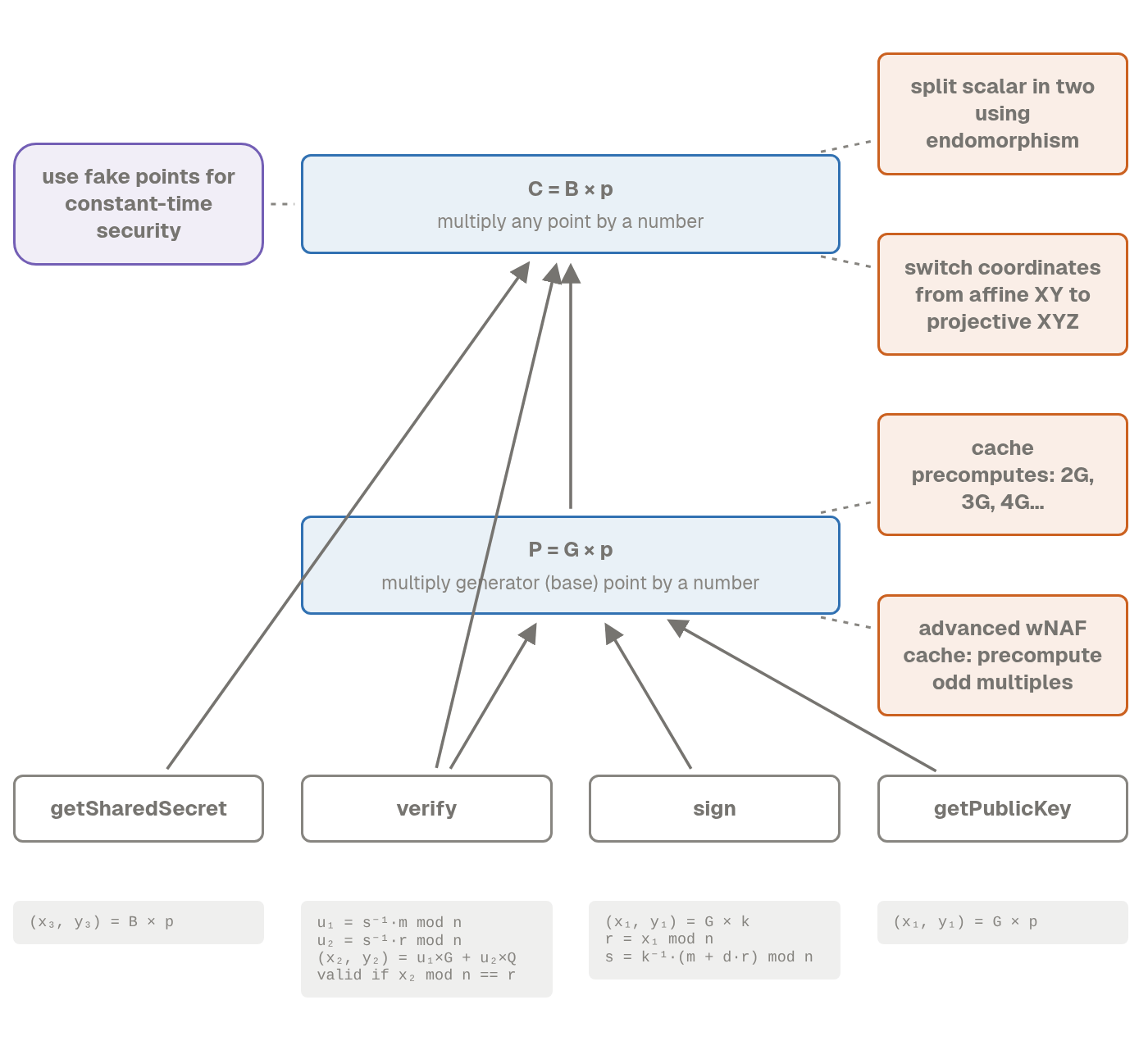
Let’s combine 3 different multiplication algorithms to get the fastest of all worlds:
- wNAF can only be used for base / generator point, because we don’t calculate it for others
- Endomorphism is fast, but slower than wNAF. However, we didn’t write endomorphism for fake points in the article. So, it can only be used for cases when timing attacks are not relevant. One such case is verification, which does not operate on private inputs.
- For everything else there is
mul_CT, which is slower than endomorphism, but safe
Additionally, let’s implement getSharedSecret (elliptic curve diffie-hellman), and add
recovery bit to sign() output; to ensure a way to recover public keys from signatures.
// PART 7, final pub + sign + verify + shared
const assertPriv = (d: bigint) => {
  if (d <= 0n || d >= N) err("private key must be in range [1, n-1]");
};
// Check y² = x³ + 7: rejects garbage keys & prevents invalid-curve attacks on ECDH
const assertPoint = (p: AffinePoint) => {
  if (isZero(p) || M(p.y * p.y) !== M(p.x ** 3n + 7n)) err("point not on curve");
};
const mul = (q: AffinePoint, n: bigint, safe = true) => {
  if (equals(q, Point_BASE)) return mul_G_wnaf(n);
  return safe ? mul_CT(q, n) : mul_endo(q, n);
};

function getPublicKey(privateKey: bigint): AffinePoint {
  assertPriv(privateKey);
  return mul(Point_BASE, privateKey);
}

function sign(msgh: Uint8Array, d: bigint): Signature {
  assertPriv(d);
  const m = M(hashToNum(msgh), N);
  let r = 0n;
  let s = 0n;
  let q: AffinePoint;
  do {
    const k = randK();
    const ik = inv(k, N);
    q = mul(Point_BASE, k);
    r = M(q.x, N);
    s = M(ik * M(m + d * r, N), N);
  } while (r === 0n || s === 0n);
  let recovery = (q.x === r ? 0 : 2) | Number(q.y & 1n);
  if (s > N >> 1n) {
    recovery ^= 1;
    s = M(-s, N);
  }
  return { r, s, recovery };
}
function verify(sig: Signature, msgh: Uint8Array, pub: AffinePoint): boolean {
  assertPoint(pub);
  const { r, s } = sig;
  if (r <= 0n || r >= N || s <= 0n || s >= N) return false; // else inv() would throw
  const h = M(hashToNum(msgh), N);
  const is = inv(s, N);
  const u1 = M(h * is, N);
  const u2 = M(r * is, N);
  const G_u1 = mul(Point_BASE, u1);
  const P_u2 = mul(pub, u2, false);
  const R = padd(G_u1, P_u2);
  if (isZero(R)) return false; // point at infinity: invalid
  return M(R.x, N) === r;
}
// Note: real-world ECDH doesn't hand out the raw point:
// derive the shared key by hashing the x-coordinate
function getSharedSecret(privA: bigint, pubB: AffinePoint): AffinePoint {
  assertPriv(privA);
  assertPoint(pubB);
  return mul(pubB, privA);
}
One subtlety: sign always outputs low-s signatures, but verify accepts high-s ones too.
For every valid (r, s) there is a second valid (r, n - s) — signature malleability. Strict
verifiers (e.g. Bitcoin consensus rules) additionally reject s > n/2.
The benchmarks look like this now:
getPublicKey: 0.241ms
sign: 0.313ms
verify: 1.083ms
While we started with:
getPublicKey_unsafe 1: 33.808ms
getPublicKey_unsafe 2: 0.28ms
sign_slow_unsafe: 26.897ms
verify_slow: 53.017ms
Awesome!
Extra tricks
One thing worth mentioning is Montgomery Batch Inversion.
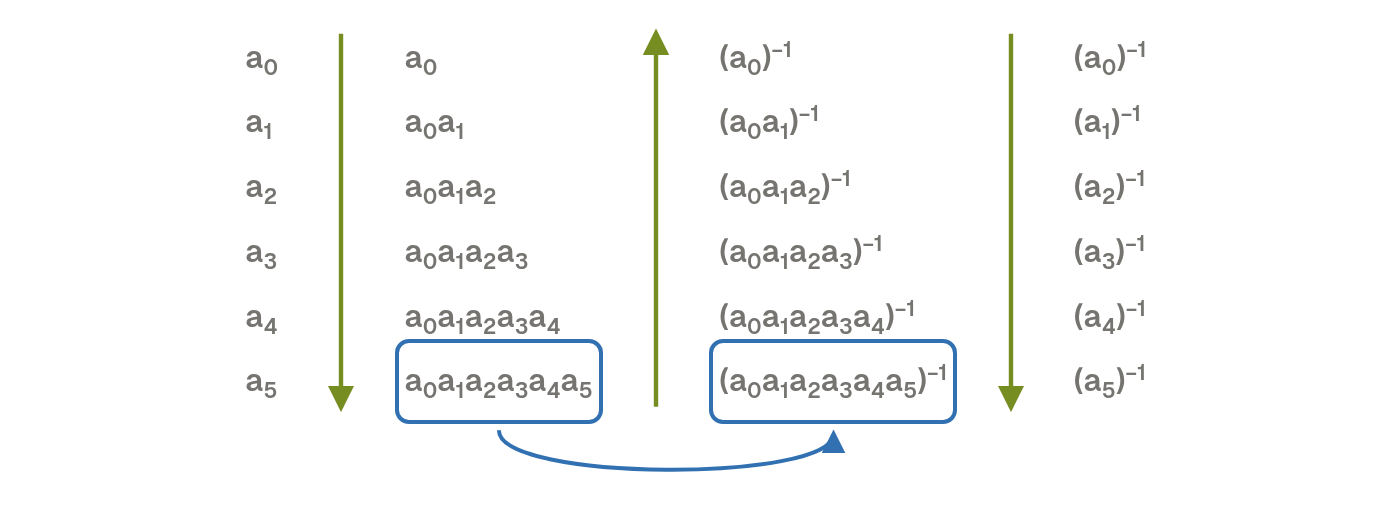
We get a bunch of numbers, do one inversion, and then apply it to all of them.
At this point, only a few call sites still use invert.
function invBatch(nums: bigint[]): bigint[] {
  const tmp = new Array<bigint>(nums.length);
  // Walk from first to last, multiply them by each other MOD p
  const lastMultiplied = nums.reduce((acc, num, i) => {
    if (num === 0n) { tmp[i] = 0n; return acc; } // 0 has no inverse, skip it
    tmp[i] = acc;
    return M(acc * num);
  }, 1n);
  // Invert last element
  const inverted = inv(lastMultiplied, P);
  // Walk from last to first, multiply them by inverted each other MOD p
  nums.reduceRight((acc, num, i) => {
    if (num === 0n) return acc;
    tmp[i] = M(acc * tmp[i]);
    return M(acc * num);
  }, inverted);
  return tmp;
}
// Batch-convert points to z=1 form, spending a single inversion on all of them
const invPointsBatch = (points: Point[]): Point[] => {
  const invZs = invBatch(points.map((p) => p.pz));
  return points.map((p, i) => Point.fromAffine(p.toAffine(invZs[i])));
};

// To enable, REPLACE in `mul_G_wnaf`:
// return invPointsBatch([p, f])[0].toAffine();
// and REPLACE in `wNAF`:
// const comp = Gpows || (Gpows = invPointsBatch(precompute()));
The gains are small, but come almost for free.
One unexpected place is wNAF: we can normalize all precomputed points to have Z=1,
which would slightly improve speed of getPublicKey and sign.
Another useful trick is Multi-Scalar Multiplication (MSM).
It is commonly implemented using Pippenger algorithm.
MSM could be used for calculating addition of many points at once:
aP + bQ + cR + .... It only makes sense to use it with bigger inputs.
Final thoughts and source code
We took sign from unsafe 26.897ms to safe 0.313ms, an 86x speed-up.
All without re-implementing bigints, esoteric math (well, besides endomorphism) and low-level languages. At this point it’s the fastest secp256k1 ECDSA lib in pure JavaScript.
Something like BIP340 Schnorr signatures can easily be implemented on top of these primitives.
- The code from the article is available:
- secp256k1-1kb.min.js — JS, parts 1+2, unsafe, fits in 856 bytes gzipped
- secp256k1-1kb.ts — TS, all methods
- noble-secp256k1 — 4kb safe, full-featured library is ready for use in all kinds of projects.
- noble-curves — larger, generic and safe standard for JS ECC cryptography, with ed25519, BLS12-381, and other algorithms
Join the journey to auditable cryptography via X.com & GitHub.